
ICARUS (Ice, Carbon, and Regolith Ultraviolet Sensor) is an ultra-compact multispectral imager designed for planetary exploration.
At just 6×6×8 cm and 302 grams, ICARUS is small enough to mount on a commercial drone or carry in a field pack. Under SCOUT, ICARUS is being ruggedized for deployment to extreme environments on Earth, analogous to Mars and other planetary surfaces.
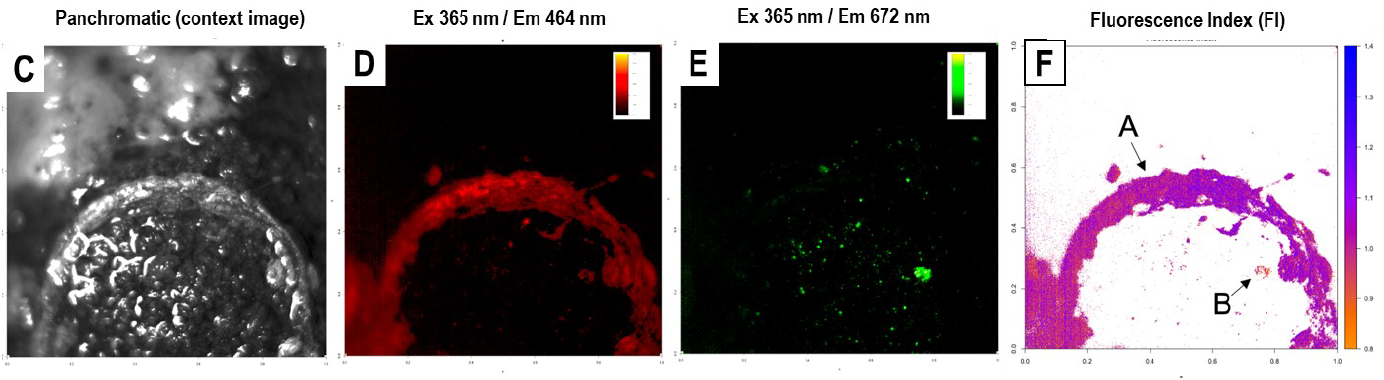
ICARUS illuminates surfaces with precisely selected wavelengths and captures the resulting fluorescence across nine spectral bands, revealing organic compounds and biological material that are invisible to the naked eye or a conventional camera. In a passive mode, ICARUS may collect reflectance data for broad categorization of rock types. The SCOUT team will test and push these capabilities by using ICARUS to analyze natural samples during repeated field campaigns.
ICARUS is currently at Technology Readiness Level (TRL) 4. SCOUT will push it through to the next development milestones.

When organic molecules absorb UV light, they re-emit it at longer wavelengths in a process called fluorescence. Compounds respond differently based on their molecular structure, environment, and the excitation wavelength used, creating a spectral fingerprint that can be captured and analyzed by ICARUS.
ICARUS uses four wavelengths to excite different classes of organic compounds, providing a richer picture of organic matter fluorescence compared to a single-wavelength instrument.
By analyzing the fluorescence signal across nine emission bands, ICARUS can map the distribution and quality of complex organic matter:
Indicates the presence of recently produced, biologically active organic matter.
Distinguishes degraded, humified organic matter from fresh biological sources.
Distinguishes microbially derived organic matter from terrestrial plant sources.
A direct indicator of photosynthetic organisms including algae and cyanobacteria.
ICARUS has an onboard GPU pipeline that processes all nine spectral bands in under 50 milliseconds, which is 300 times faster than an equivalent Python-based software pipeline, delivering fluorescence index maps in the field in real time.
This enables operators to make informed decisions about where to sample and sample selection during the traverse itself, rather than discovering results later in the lab.